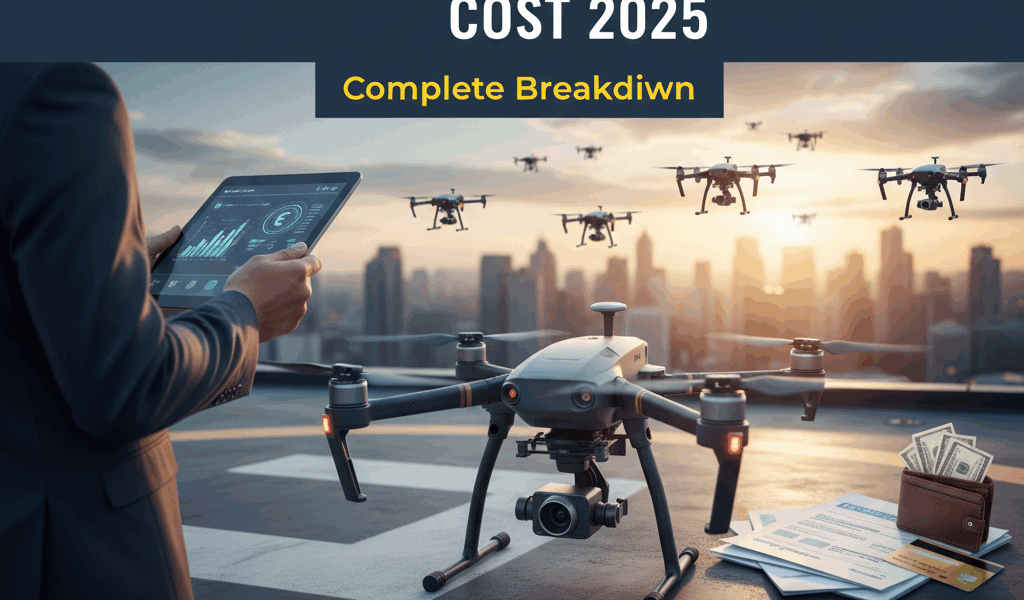
Commercial drone licensing costs have gotten complicated with all the study courses, equipment options, and insurance requirements flying around. As someone who got my Part 107 certification last year and tracked every dollar spent, I learned everything there is to know about what this process actually costs. Today, I will share it all with you.
Flying drones commercially in the United States requires FAA certification, and that certification costs money—though exactly how much depends on your starting point and how you approach the process. The mandatory costs are surprisingly reasonable; the optional expenses can add up quickly.
The Mandatory Costs
The FAA requires a knowledge test administered at designated testing centers. The test fee runs $175. That’s set by the testing providers, not the FAA, but they all charge roughly the same. You can’t negotiate this one—everyone pays it.
The test covers airspace, weather, regulations, and operations. Sixty questions, multiple choice, 70% to pass. The knowledge requirements are genuine but achievable with proper preparation.
There’s no flight test for Part 107. That’s what makes this certification endearing to us pilots coming from other fields—unlike pilot certificates for manned aircraft, the FAA doesn’t require demonstrated flight proficiency. You prove you understand the rules and safety principles; your actual flying ability is your problem.
TSA background check is included in the process but doesn’t add direct cost. The FAA vets applicants through TSA before issuing certificates. Most applicants clear without issues.
Total mandatory cost: $175. That’s it for the federal requirements.
Study Materials
Probably should have led with this section, honestly. How you prepare for the knowledge test determines whether you spend nothing additional or several hundred dollars. Multiple approaches work; each has cost implications.
Free resources exist and work for self-disciplined learners. The FAA publishes study guides, test prep materials, and documentation covering everything on the exam. If you learn well from reading and can motivate yourself without structure, this approach costs nothing.
Commercial study courses range from $50 to $300 depending on features. Video lectures, practice tests, guarantee policies, and flashcard systems differentiate providers. Drone Pilot Ground School, Pilot Institute, and UAV Coach are popular options.
The practice tests matter more than the lectures for many people. Understanding why wrong answers are wrong reinforces the concepts more effectively than passive video watching.
My recommendation: start with free FAA materials, take a free practice test, and only buy a course if you’re struggling. Many people pass with minimal investment; others need structured instruction. Know which type you are before spending.
Time Costs
Study time varies from 10 hours to 40+ hours depending on your background and study style. Former pilots or aviation professionals might breeze through in a weekend. Complete newcomers to airspace and regulations need more time.
The opportunity cost of that study time is real, even if you’re not paying for courses. Most people can prepare adequately in 2-4 weeks of casual study.
Equipment Considerations
The license itself doesn’t require owning a drone—you could theoretically get certified and fly someone else’s equipment. But most commercial operators own their own aircraft, and that’s where costs really start climbing.
Entry-level commercial drones start around $500 for the DJI Mini series. These work for basic photography and videography but lack features that demanding commercial work requires.
Professional-grade drones range from $1,000 to $15,000 depending on capabilities. The DJI Mavic series ($1,000-2,000) handles most commercial work. Specialized platforms for inspection, mapping, or cinematography cost considerably more.
Accessories add up: spare batteries ($50-200 each), cases, memory cards, filters, monitors. A fully equipped professional kit typically runs 2-3x the drone price when accessories are included.
Insurance is technically optional but practically mandatory for commercial work. Liability coverage for drone operations runs $500-1,500 annually depending on limits and claims history.
Ongoing Costs
Part 107 certificates expire after two years. Renewal requires passing either another knowledge test or completing online recurrent training. The current recurrent training is free through FAA sources, but that could change.
Staying current with regulation changes requires ongoing attention. Airspace authorizations, Remote ID requirements, and operational rules evolve continuously.
What Commercial Operators Actually Spend
Getting the certificate: $175-400 (test fee plus optional study materials).
Getting flight-ready: $800-3,000 (entry-level to mid-range drone plus accessories).
Operating legally: $500-1,500/year (insurance).
Total first-year investment for a new commercial operator: roughly $1,500-5,000 depending on equipment choices and study approach.
That’s actually quite accessible compared to other professional certifications and equipment. The barriers to entry are low enough that the market has become competitive.
Is It Worth It?
Commercial drone work ranges from highly profitable specialty services to commoditized work that barely pays. The certification cost isn’t the gating factor; the business opportunity is.
Real estate photography, the most common entry point, has become price-competitive. Specialized services—inspection, mapping, cinematography—command better rates but require additional skills and often more expensive equipment.
The certification opens doors, but walking through them profitably requires more than a piece of paper. Treat the licensing cost as the beginning of the investment, not the total.

Leave a Reply